How to make it
6 steps. Take it one step at a time.
Blend the chopped pandan leaves
Blend the chopped pandan leaves with 250 ml (1 cup) of water until fine. Strain through a muslin cloth or fine sieve to extract the green pandan juice, squeezing well to get all the color and aroma.
Whisk together the rice flour, mung bean starch, 250 ml pandan juice
In a heavy-bottomed pot or wok, whisk together the rice flour, mung bean starch, 250 ml pandan juice, and 250 ml (1 cup) of limestone water until smooth and no lumps remain.
Place the pot over medium-low heat
Place the pot over medium-low heat. Stir constantly with a wooden spoon or spatula. The mixture will begin to thicken and turn translucent. Continue stirring until it becomes a very thick, sticky, and glossy paste (about 10-15 minutes).
15 minPrepare a large bowl filled
Prepare a large bowl filled with cold water and some ice. Place a Lod Chong press (or a large-holed colander) over the bowl. Transfer the hot dough into the press and use a spatula to push the dough through the holes into the cold water. The droplets will form short noodles. Let them sit in the cold water for 5 minutes to firm up.
5 minTo make the syrup
To make the syrup, combine coconut milk, palm sugar, and salt in a small saucepan over medium heat. Stir until the sugar is completely dissolved and the mixture just reaches a simmer. Do not boil vigorously or the coconut milk may separate. Remove from heat and let it cool slightly.
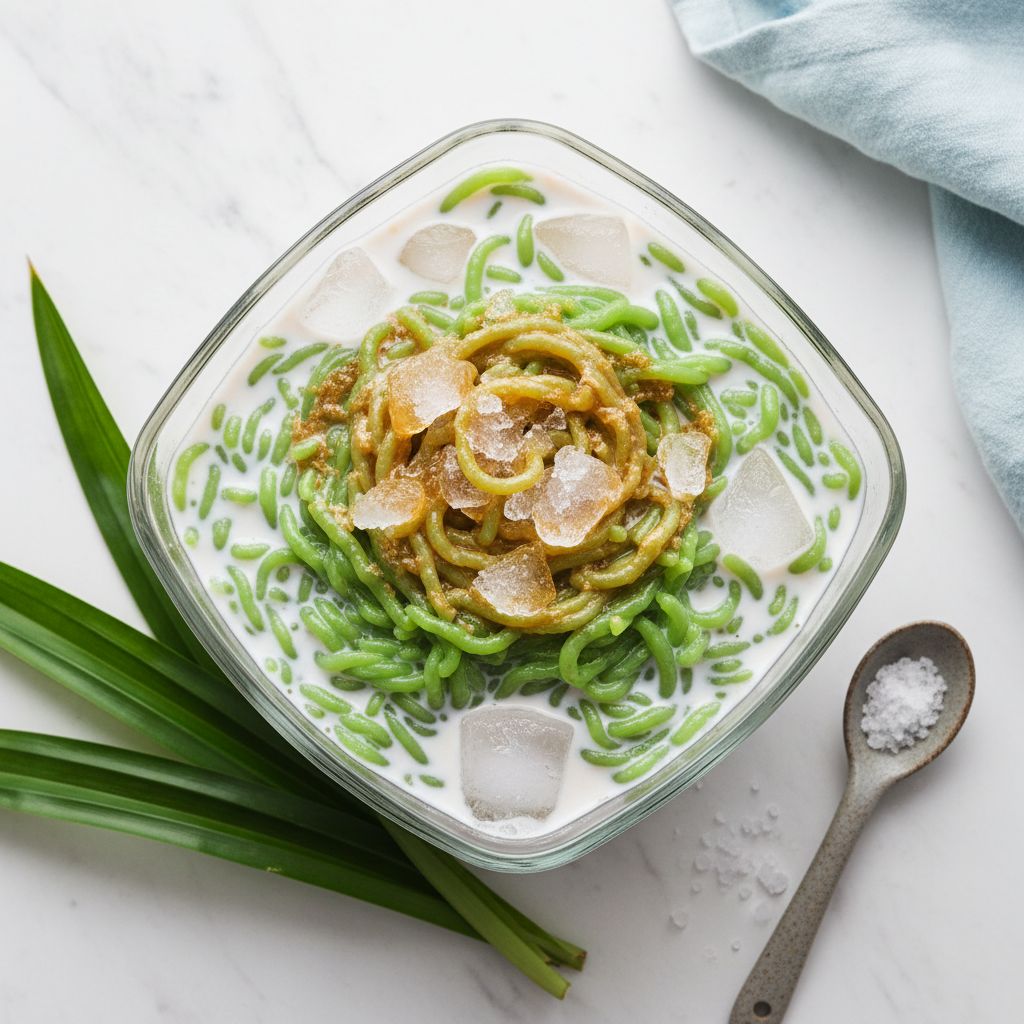
To serve, place a portion of the green noodles
To serve, place a portion of the green noodles in a bowl, pour over the sweet coconut milk syrup, and top with plenty of crushed ice.
A little kitchen wisdom
Using mung bean starch along with rice flour creates a more translucent and bouncy texture. For the most authentic flavor, use high-quality palm sugar which has a deep, caramel-like taste. The limestone water (calcium hydroxide solution) is critical for the noodles to hold their shape and have a firm 'snap'.